Go
$30/ month
Up to 125M tokens, resets monthly
API benefits
- Up to 125M tokens every month
- All models, one key
- Heavier models draw faster
- Up to 1M-token context
Compute
- 4 GB RAM · 2 vCPU VPS
- Full root on Windows or Ubuntu
One OpenAI-compatible /v1 key for the full model catalog: up to 1M-token context, a free 24/7 Qwen 3.8 27B coding lane, and an NVMe server included on every plan. Tokens reset every month.
Up to 125M tokens, resets monthly
Up to 250M tokens, resets monthly
Up to 500M tokens, resets monthly
Up to 1B tokens, resets monthly
Up to 2B tokens, resets monthly
Every plan includes an OpenAI-compatible key, monthly token reset, and a dedicated VPS.
30 models in the fleet - 23 live now, 7 coming soon. OpenAI-compatible, up to 1M-token context, with a server on every plan.

Flagship 1T deep-reasoning model for architecture, scientific logic, and hard debugging.
Pinned 0813 DeepSeek V4 Pro checkpoint for deterministic long-running agent deployments.
High-throughput 1017 coding workhorse (90.6% Terminal-Bench 2.1, 384K max output).
Ultra-low-latency DeepSeek tier for rapid routing, triage, and high-concurrency sub-agents.
1T flagship for multimodal UI/OCR understanding, competition math, and algorithmic synthesis.
Fast 397B multimodal throughput model for code, vision OCR, and streaming workflows.
Dedicated 24/7 unmetered builder lane (0% monthly token burn) on every plan.
Strict JSON schema adherence, reliable multi-tool calling, and multimodal agent control.
High-speed structured extraction & fast tool-calling GLM 5.3 tier.
Stable 355B previous-generation GLM lane for legacy structured prompts.
Proven GLM 5.1 baseline preserved for backward-compatible pipelines.

Whole-repo ingestion, video + image + text comprehension, and formal proofs.
Next-gen Kimi K3.1 Pro flagship for deep agentic planning and long-context coding.
Accelerated Kimi K3.1 Pro lane tuned for interactive speed in IDEs and swarms.

Live 428B MoE agentic core (23B active) tuned for sustained multi-turn execution.
Ultra-fast M3.1 Flash generation for rapid tool-calling and responsive sub-agents.

ByteDance 3.2T multimodal flagship: 98.3% AIME, 94.2% tau2-Bench, 89.5% Video-MME.
High-speed Seed 2.1 tier trading peak size for fast interactive throughput.
Lightweight Seed 2.1 lane for fast classification, extraction, and scalable fan-out.
Proven Seed 2.0 Pro multimodal tier maintained live for compatibility.
Code-specialized Doubao Seed model tuned for repository editing and tool chains.
Fast Seed 2.0 Lite workhorse for high-volume extraction and classification.
Ultra-light Seed 2.0 Mini for millisecond routing, parsing, and lightweight bots.
Legacy Moonshot K2/2.7 family queued for backward-compatible evaluation runs.

Tencent Hunyuan 770B enterprise reasoning model (49B active MoE) queued next.

StepFun 600B flagship preview (27B active) queued for high-throughput reasoning.
Earlier StepFun 3.7 / Step-3 Flash generations queued for compact fast lanes.
Earlier Qwen sparse 397B (17B active) multimodal checkpoint queued for eval continuity.

Xiaomi MiMo V2 Flash & Pro sparse reasoning series queued for upcoming activation.
Legacy MiniMax M2.7 10B-active lineage queued alongside live MiniMax-M3.
Your tokens reset every month. No surprise per-token invoice at the end of the month.
Qwen 3.8 27B runs all day on a dedicated lane that never draws down your monthly tokens.
Full root on Windows or Ubuntu with NVMe storage. Your own machine, not a shared container.
A single OpenAI-compatible /v1 endpoint with up to 1M-token context across the live catalog.
Dedicated Windows compute with full Administrator access, NVMe storage, and flexible billing.
A few Discord bots or cron scripts, without paying for idle capacity. Full Administrator access on NVMe.
One busy bot plus its database, panel and backups, online all day. Reboots without taking the stack down.
Several bots, a control panel and a queue worker on one machine. Enough headroom for traffic spikes.
High-traffic bots with headroom for spikes and restarts. NVMe keeps the database quick under load.
Parallel job runners and scraper fleets that cannot sit in a queue. Every core stays busy, all day.
Dense workloads: many bots and many workers on a single box. Memory to spare for each process.
Build runners and CI jobs alongside production bots. Compiles finish while the fleet keeps serving.
Serious concurrency for trading bots, crawlers and realtime services that cannot wait on a queue.
Sustained throughput for large bot fleets and streaming pipelines. Plenty of RAM for every worker.
Memory-hungry services, large caches and heavy databases. Room for the whole stack on one host.
Multi-tenant bot hosting, or a whole stack of services on one host. Isolated processes, shared metal.
Scale-out automation with memory to spare for growth. Add workers without adding another invoice.
Enterprise bot operations with dozens of services and no contention. Cores for the busiest hours.
Flagship core counts for the heaviest automation stacks. Built to stay flat under sustained load.
Run an entire platform: frontend, workers, database and cache. One machine, no network hops between them.
Rack-scale compute shared across teams and environments. Split it into VMs or run it as one box.
Massive parallelism for data pipelines and simulation work. Every thread has memory behind it.
Top of the ladder: maximum cores and memory for anything you throw at it. No compromise tier.
Your dedicated RTX PRO 6000 & AMD EPYC™ environment comes pre-configured with DeepSeek Harness, Hermes, and OpenClaw out of the box. Enjoy dedicated privacy, live state snapshots, and zero rate limits across your optimized AgentOS.
Windows or Ubuntu, preloaded with OpenWebUI, DeepSeek Harness, Hermes, and OpenClaw. Log in and deploy your swarms.
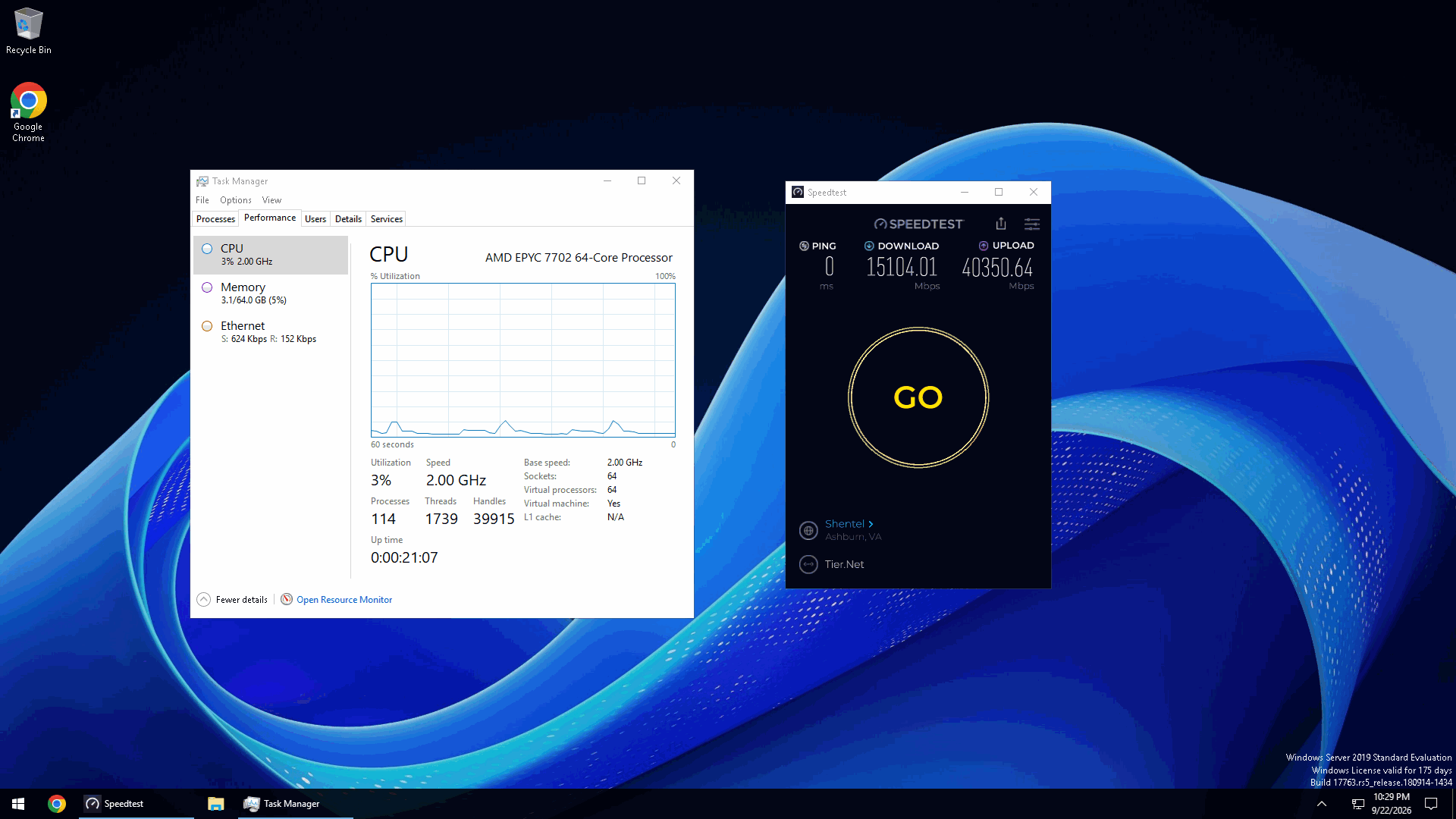
Burst past 10,000 TPS on RTX PRO 6000 hardware. No rate limits, no API queues, no per-token fees.
Agent state is fragile. Automatic environment snapshots let you roll back to a known-good state when a swarm crashes.
Your weights, your prompts, your data. Bare-metal isolation means no shared tenants and no third-party access to your workloads.
ECC memory paired with GPU acceleration, sized to hold up to 1M-token context windows in memory.
Direct uplinks to 100 Gbps transit. Your agents can crawl, pull, and ingest data at scale without saturating the pipe.
Up to 14,000 MB/s reads and writes. Model weights load fast, and storage stops being the bottleneck.
AMD EPYC™ 9274F processors with up to 48 cores, 4.3 GHz boost clocks, and large L3 cache for parallel agent workloads.
The price, speeds, and limits on your plan today stay fixed for life. No forced migrations. No surprise changes.
Covered by a 100% uptime SLA from our enterprise datacenter. Your fleet stays online 24/7.
Internal OS optimization scripts and custom BIOS settings, tuned for system, GPU, and network throughput.
When new frontier models ship, we add them to your cluster. No migration and no plan change required.
Setup, model access, infrastructure, and support, answered before you pick a plan.
Each plan combines dedicated NVMe server resources (Windows Server 2022 or Ubuntu), a 24/7 Qwen 3.8 27B coding lane, and an OpenAI-compatible API key for all 23 live frontier models.
Yes. Every server can be delivered on Windows Server 2022 or Ubuntu LTS with full Administrator or root access.
All five AI Coding Plans include all 23 live models and up to 1M-token context. Higher tiers scale your monthly token allowance (from 125M up to 2B tokens/month) and double your dedicated VPS RAM and vCPU cores.
Yes. Point DeepSeek Harness, Cursor, Cline, Roo Code, Hermes, or any OpenAI SDK at our /v1 base URL with your key.
Your token allowance resets every 30 days on all billing cycles, while 3-month terms save 20% and 6-month terms save 25% off the monthly rate. The discount applies to price only - your token bank still resets every month.
Yes. Dedicated GPUs, multi-GPU systems, blade deployments, and larger reserved environments can be scoped directly with the infrastructure team. Start a custom quote.
Our engineering team handles support directly: provisioning, infrastructure, networking, and account questions.
Legacy machine, multi-GPU cluster, blade system, or full cabinet. Talk directly with the team about capacity, networking, and deployment.